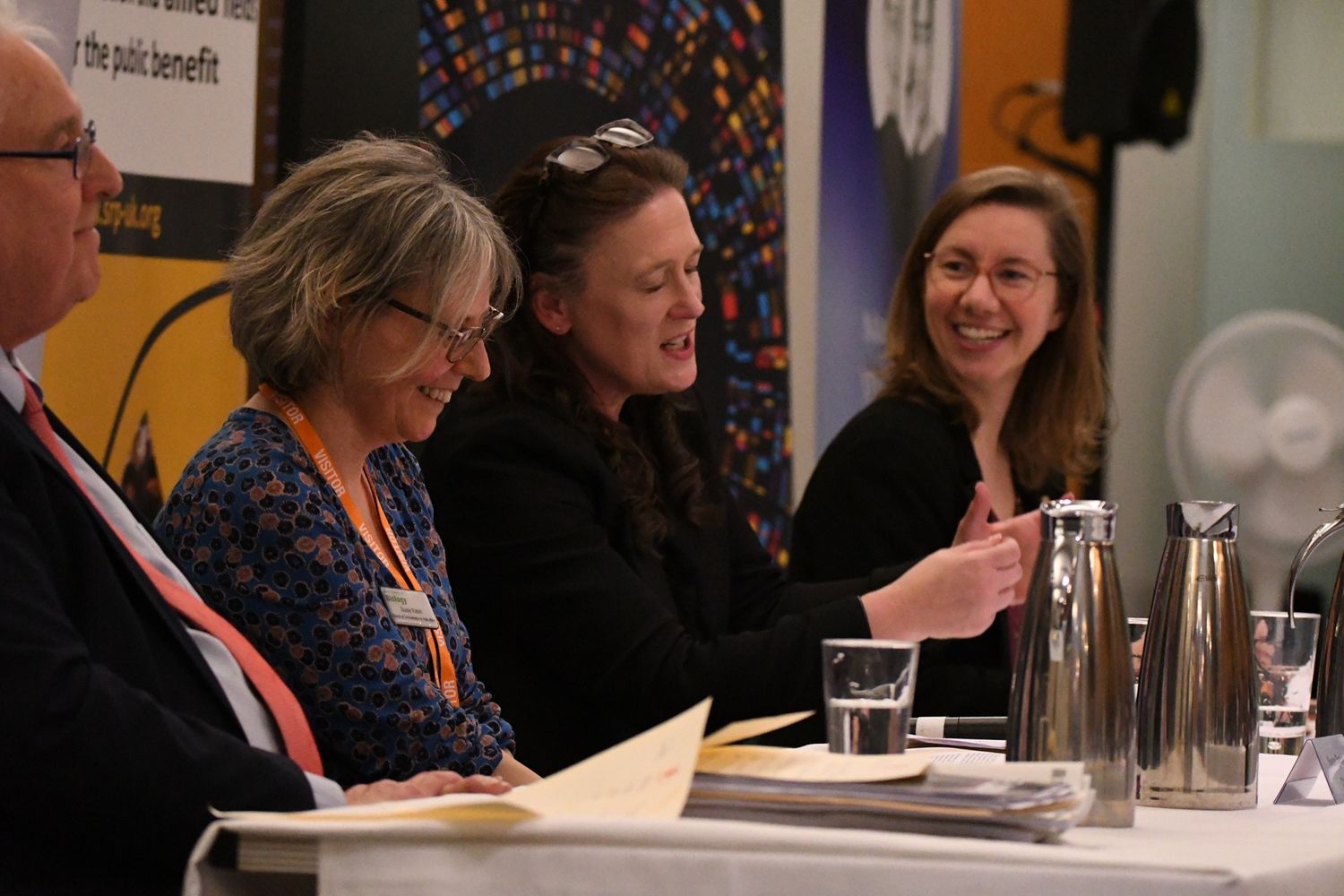
Role reversal: early career scientists quiz Parliamentarians in Voice of the Future 2026
Date: 26 Mar 2026
The Parliamentary Steering Group's (PSG) annual event, Voice of the Future, run by the Royal Society of Biology, was held at the House of Commons on Thursday 19 March 2026. The event is an opportunity for early career researchers to put their most pressing STEM questions to Parliamentarians and science advisors.
This year's event was chaired by the RSB's Director of Communications and Public Affairs Susie Rabin. We were delighted to have over 70 attendees present for the two panel sessions.
First session
The first panel consisted of Victoria Heath FRSB, Chief Healthcare Science Officer Wales, and Professor Catherine Ross CBiol FRSB, Chief Scientific Officer Scotland, answering a range of questions from PSG representatives. Highlights of some of their answers are outlined below.
Victoria kicked off the first session by answering questions from school students at Bishop’s Hatfield Girls’ School and St Luke's High School pertaining to how the skills learned in STEM subjects can be used in everyday life and what skills students should focus on developing. Victoria suggested school students should pursue what they enjoy and are good at, and to always remain curious. She also mentioned how science communication is hugely important and that there is a wide array of transferrable skills learned in STEM that are applicable in various fields.
The Biochemical Society asked about national health data and research infrastructure while the British Society for Immunology queried how UK governments and scientists can work together to rebuild public trust following the pandemic. Victoria stated that improving communication is key and that it needs to be adapted to different audiences to have the greatest effect.
Catherine then answered the British Pharmacological Society's question on the inclusion of pregnant people in clinical trials and what steps the UK Government could take to counter misinformation surrounding this. Catherine stated that the Scottish Health Information Integrity Strategy has been published recently, the first of its kind. This directly addresses the issues of dis- and misinformation in order to build public trust while looking at best practise and evidence across different nations globally. Applied Microbiology International's questions centred on how the government plans to tackle public safety this winter during flu season and the effect of pollutants on the gut microbiome. Catherine shared that the Scottish Government prepares for winter season year-round in anticipation of flu season and to not cause undue strain on the NHS.
Second session
The Viscount Stansgate, member of the House of Lords Numeracy for Life Select Committee, Emily Darlington MP, member of the Science, Innovation and Technology Committee, and Dr Lauren Sullivan MP, Chair of the Parliamentary Office of Science and Technology (POST), comprised the panel for the second session.
Both Emily and the Viscount Stansgate shared their views on the London Mathematical Society's question on how the UK can address the teacher shortage in mathematics, particularly at secondary and post-16 level.
The Genetics Society posed a question on the Government's commitment to international collaboration and improving research resilience. Emily stated that investing in blue skies, applied research, and scaling up are crucial. Long-term planning is required and having re-joined Horizon is a step in the right direction.
Lauren gave insight into the Royal Society of Chemistry's question pertaining to Government investing in STEM early career scientists to secure skilled jobs, aligned with the Government's Industrial Strategy. She said there needs to be a push for retaining talent, particularly when other nations have better incentives, through providing security via longer work plans and contracts.
The final questions to close the session came from The Geological Society and the British Ecological Society regarding what the UK Government is doing around flood risk planning and elevating biodiversity alongside climate action. Lauren answered by saying this requires a multi-faceted approach, communication, and longer-term planning, and she offered to raise the issue of flood planning with the relevant Minister.
The evening ended with the opportunity to network over drinks and canapés.
The RSB would like to thank Victoria Heath FRSB, Professor Catherine Ross CBiol FRSB, the Viscount Stansgate, Emily Darlington, and Dr Lauren Sullivan, in addition to all the attendees, those who submitted questions, and the PSG member organisations for their contributions.
PSG representatives
The PSG is comprised of: Anatomical Society, Applied Microbiology International, Association of Applied Biologists, Biochemical Society, British Ecological Society, British Pharmacological Society, British Society for Immunology, London Mathematical Society, The Genetics Society, The Geological Society, Institute of Physics, Royal Society of Biology, Royal Society of Chemistry, Society for Experimental Biology, and The Society for Radiological Protection.

Top image: The Viscount Stansgate, Susie Rabin, Emily Darlington MP, Dr Lauren Sullivan MP
Bottom image: Institute of Physics PSG representative